Optees — Optimization Toolkit
🟢 Active
Optees is an open-source desktop workbench that turns mathematical models and small datasets into local, reproducible, understandable workflows. The app combines SciPy/HiGHS, OR-Tools, dedicated solvers, Dijkstra, and educational machine-learning models in a PySide6 interface built for students, analysts, and developers who want to inspect not only the result, but also the mathematical contract, limits, and evidence behind each solution.
Tech stack
Type
Category
Platform
Download
 Desktop releases on GitHubChecking...
Optees is open source: you can read the code, follow the roadmap, open issues, or propose improvements.
GithubOpen the public landing page to see real screens, supported platforms, and available releases.
 Visit the website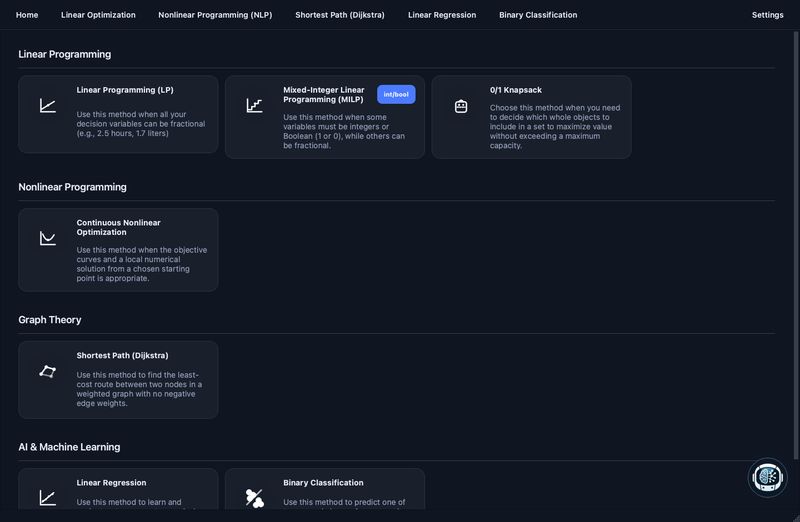
A local workbench for optimization models
The home screen organizes problem families into consistent workflows: Linear Programming, MILP, Knapsack, continuous Nonlinear Programming, Graph Theory, and AI & Machine Learning. Each path guides formulation, validates inputs, and keeps data on the desktop without mandatory accounts or cloud services.
PySide6 • Local workflows • Deterministic assistant
Inspectable LP and MILP results
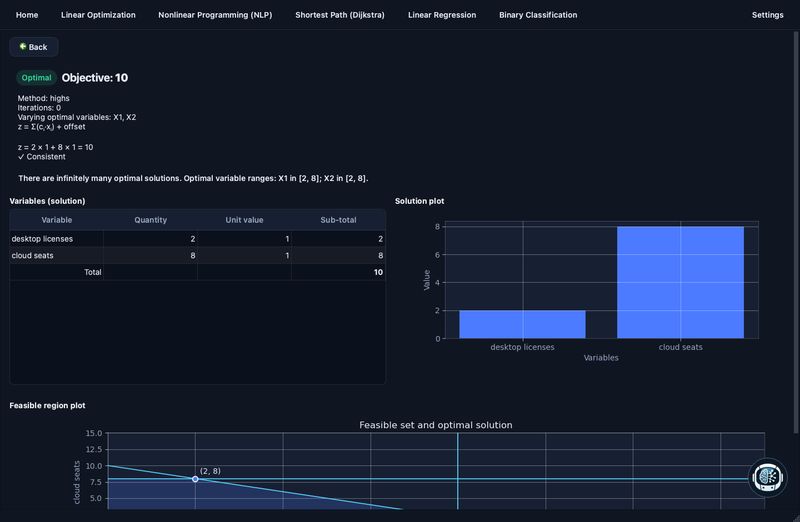
Linear models use SciPy/HiGHS and show status, objective value, variables, alternative-optimum ranges, and the feasible region when dimensionality allows. Mixed-integer models integrate OR-Tools with continuous, integer, and binary variables while keeping time limits, gap, and solver status explicit.
SciPy/HiGHS • OR-Tools • Optimal ranges
Five Knapsack variants in one flow
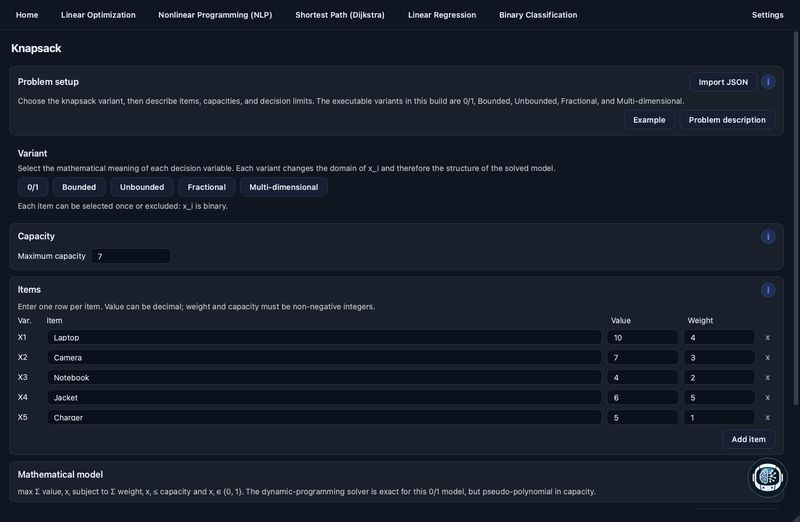
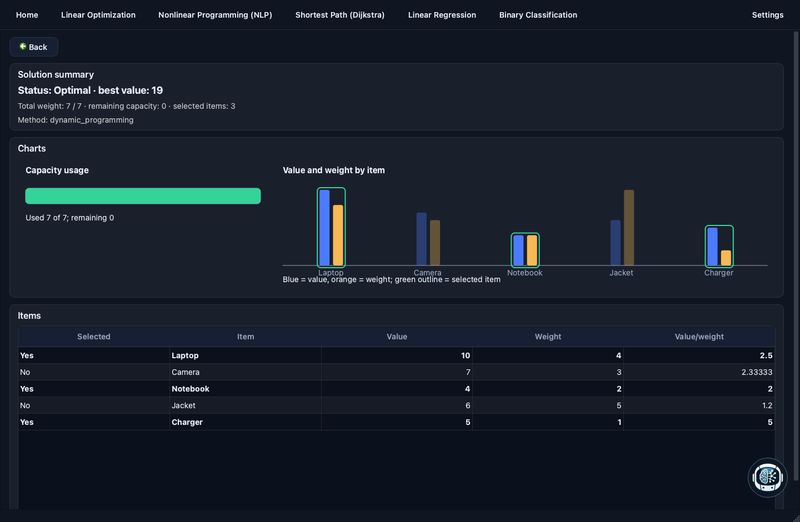
The Knapsack module covers 0/1, Bounded, Unbounded, Fractional, and Multi-dimensional variants. The same interface lets users choose the variant, capacity, and items, then compare value, weight, selected quantities, and resource usage through dedicated tables and visualizations.
0/1 • Bounded • Unbounded • Fractional • Multi-dimensional
Continuous NLP and graphs with honest contracts
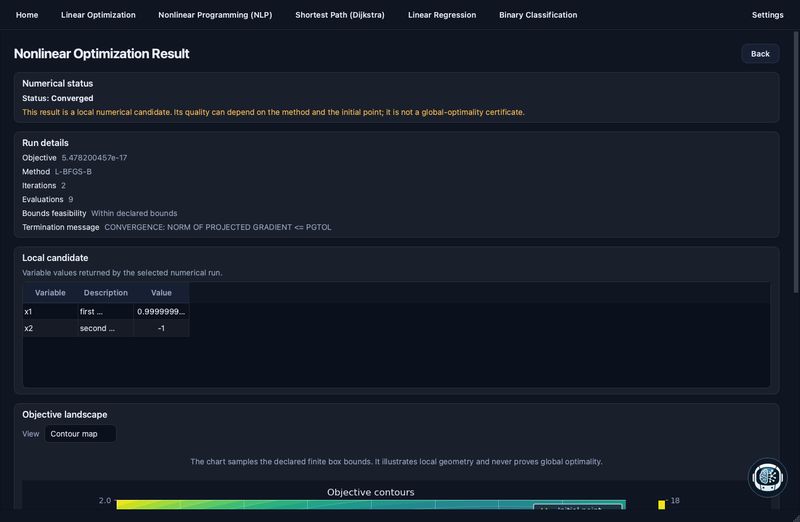
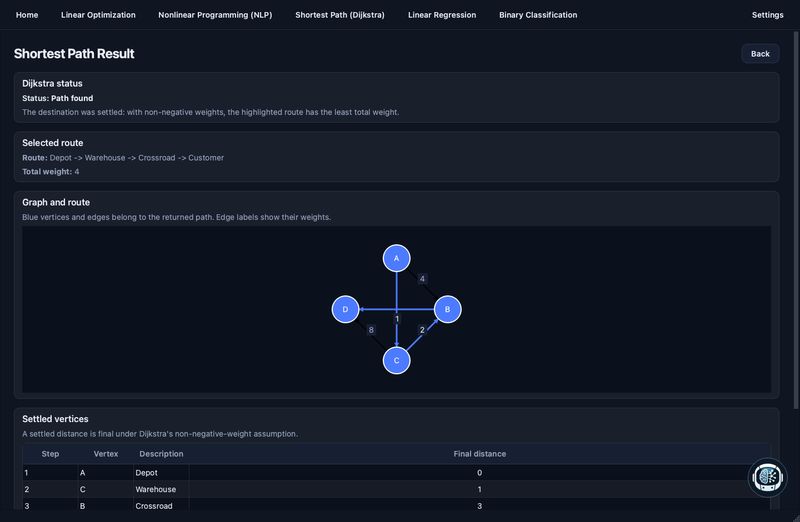
Continuous nonlinear programming accepts safe scalar expressions, an initial point, optional bounds, and BFGS, Nelder-Mead, or L-BFGS-B methods. The view makes clear when the result is a local candidate rather than a global proof. The graph module solves Dijkstra shortest paths with non-negative weights and shows route, cost, and deterministic trace.
Local NLP • Dijkstra • Explicit guarantees
Educational, reproducible machine learning
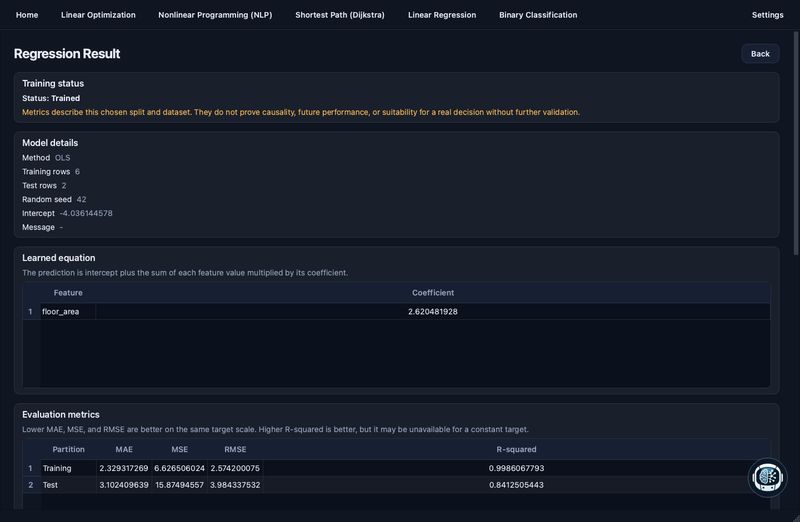
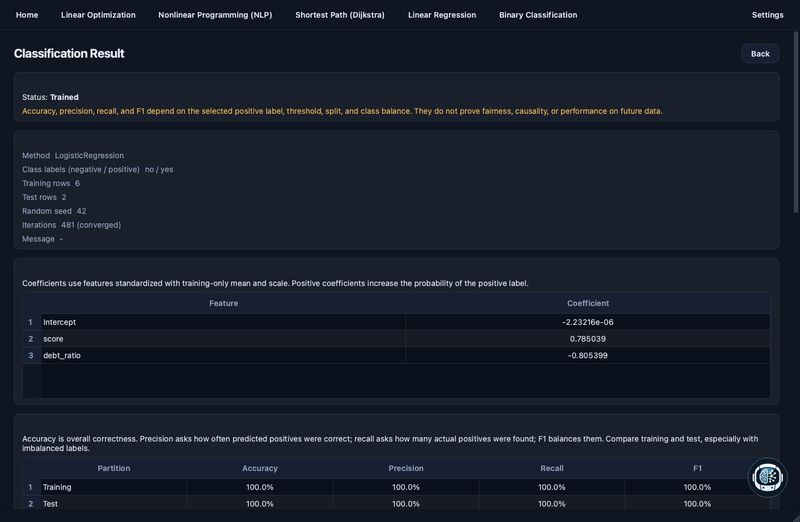
Optees includes OLS/Ridge Linear Regression and local Binary Classification through logistic regression. Each training run uses deterministic splits, explicit seeds, held-out metrics, coefficients, residuals, confusion matrices, probabilities, and notes that separate prediction, fit quality, and causality.
OLS/Ridge • Logistic regression • Reproducible splits
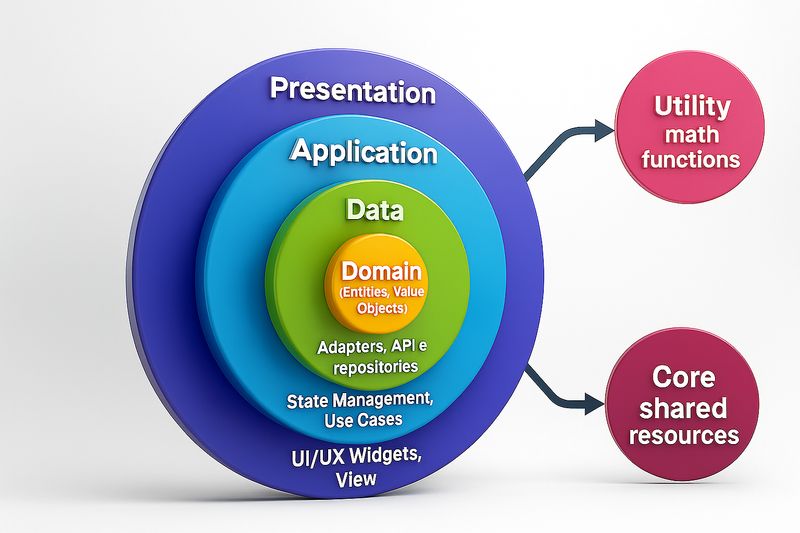
Clean Architecture, MVVM, and TDD
The diagram reflects the architecture actually adopted by Optees: MVVM-style Presentation, Application use cases, Data adapters, pure Domain models, plus Core and Utility layers for shared services and numerical routines. The project has grown through a TDD workflow and now keeps more than 600 green tests. The suite includes scientific benchmarks and reference cases imported from different formats for each family: LPnetlib MAT files for LP, MIPLIB MPS/MPS.GZ plus SOLU files for MILP, Burkardt and OR-Library data for Knapsack, plus documented analytic cases for NLP, regression, classification, and graphs.
Clean Architecture • MVVM • TDD • 600+ green tests
A desktop product that makes optimization easier to inspect
Optees was built to bring Operations Research and educational machine learning closer to people who want to model decisions, verify results, and understand numerical limits without hiding behind a black box.